How to Teach Kids Early Math Without a Worksheet: The Case for Weaving
A few weeks ago, at our kitchen table, my almost-8-year-old was making a birthday card for his dad. He stuck strips of washi tape across the front in his own row of stripes. He wasn't trying to make a pattern. He just liked alternating a striped tape with a polka-dot one. Every few strips, he stopped and squinted at the row. Then he peeled one off because it broke the order he'd started. He wasn't thinking about math at all. He was thinking about whether the card looked good enough for dad. But he was actually doing something important. He was predicting what came next in a sequence. He was catching his own mistake when the pattern skipped a beat. That is one of the clearest building blocks of early math thinking.
That's the part I wish more parents knew. We don't always need a worksheet to teach math. We need a pattern, a pair of hands, and a little time.
The research behind the hands
For a long time, "patterning" was treated as a nice-to-have. Patterning means recognizing and extending a sequence, like over, under, over, under. It was seen as something kids picked up on the side, while the real math happened with numbers and counting.
A 2019 Vanderbilt University study put that assumption to the test. It was led by Erica Zippert, along with Kelsey Clayback and Bethany Rittle-Johnson. They studied 66 preschoolers. They found that patterning ability predicted both general math knowledge and numeracy skills, even after accounting for the kids' general reasoning ability. Patterning wasn't just a proxy for being smart. It explained real, additional variance in math skill on its own (Zippert, Clayback and Rittle-Johnson,2019). Their conclusion was that finding rules and regularities in repeating patterns deserves a place in early childhood curricula, right alongside counting and number recognition.
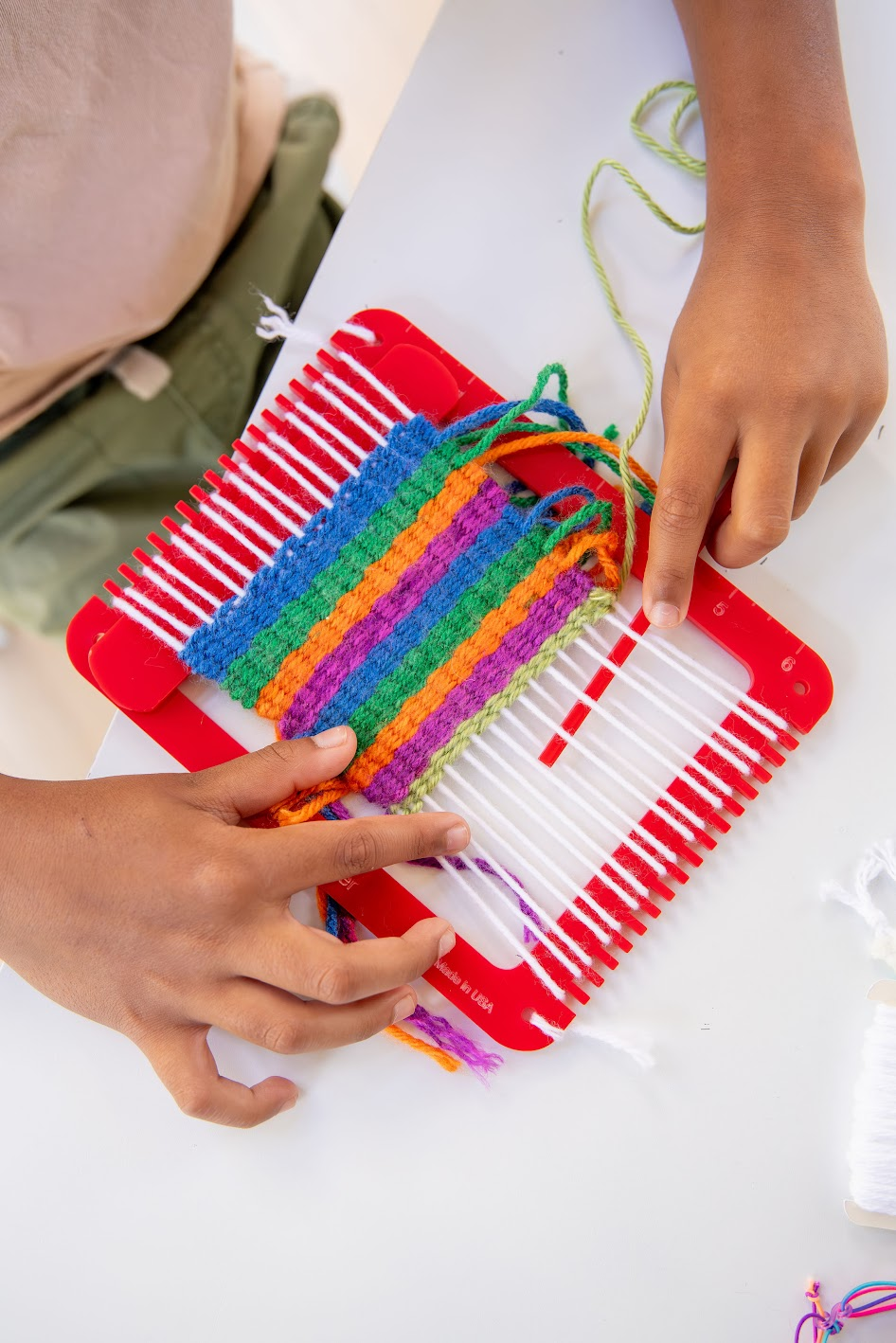
So what is actually happening while a kid weaves?
- Sequencing. Over, under, over, under. Recognizing and continuing a pattern is the same cognitive move as continuing a number sequence.
- Prediction and error checking. When a strip is out of order, the pattern visibly breaks. Kids notice and fix it themselves. That is a much stronger learning loop than being told an answer is wrong.
- Spatial reasoning. Rows, columns, and the grid they form are an early, tactile introduction to coordinate thinking.
- Persistence. A weaving project takes sustained attention across many small, similar steps. That is a kind of patience and mindfulness that worksheets rarely ask for.
How to actually try weaving and patterning at home

A few things that make it go better:
- Let the pattern break. Resist the urge to fix a mistake for them. Point at the break and ask, "does that look right to you?" That does more for math thinking than a correction does.
- Name the pattern out loud, once. Say "over, under, over, under" the first time. That gives them language for what their hands already know.
- Keep it short. Ten to fifteen minutes is enough for a young child. The goal is a few good reps of noticing and predicting, not a finished masterpiece.
- Let color be the reward. Kids will redo a row for the "right" color combination far more willingly than for a "right" answer. Use that.
A paper strip project might turn into something your kid wants to come back to. That's usually the moment we point people toward an actual loom. That is the whole reason I started Weave-n-Wonder. But you don't need one to start. You need a strip of paper and about ten minutes this week.
Zippert, E., Clayback, K. & Rittle-Johnson, B. (accepted August, 2019). Not Just IQ: Patterning Predicts Preschoolers’ Math Knowledge Beyond Fluid Reasoning. Journal of Cognition & Development. Link: Zippert, Clayback & Rittle-Johnson, Vanderbilt University,
Erikson Institute's Early Math Collaborative : https://www.earlymathca.org/